Chemistry Journal of Moldova
- Journal Citation Reports for year 2025:
- Impact Factor (IF) 0.5;
- 5-year Journal IF 0.6;
- SCOPUS Journal Metrics for year 2025:
- CiteScore 0.9;
- Source Normalized Impact per Paper (SNIP) 0.334;
- SCImago Journal Rank (SJR) 0.152.




TOP DOWNLOADED ARTICLES
1. SONOCHEMICAL SYNTHESIS OF HEMATITE
NANOPARTICLES
Mihail Iacob
(downloads: 1342)
2. THE ROLE OF HALOGEN BONDING IN THE
SYNTHESIS AND DESIGN OF TAP COMPLEXES
Namiq Shikhaliyev, Ayten Niyazova, Abel Maharramov, Agaisa Askerov, Nazrin Zeynalli, Viktor Khrustalev, Peri Huseynova
(downloads: 934)
3. SILVER AND ZINC NANOPARTICLES
BIOSYNTHESIS USING LAUREL EXTRACT AND
INVESTIGATION OF THE PHOTOCATALYTIC
PROPERTIES
Recep Taş, Ebru Köroğlu, Ahmet Karakuş, Ali Savaş Bülbül, Nilay Akkuş Taş
(downloads: 908)
4. SYNTHESIS OF DIFFERENT STRUCTURAL TYPES
OF ZEOLITES IN THE
HALLOYSITE-DOLOMITE-OBSIDIAN SYSTEM
Gunel Mamedova
(downloads: 870)
5. DERIVATIZATION TECHNIQUES BASED ON
CHARGE TRANSFER REACTIONS FOR
SPECTROPHOTOMETRIC DETERMINATION OF
JOSAMYCIN IN VARIOUS DOSAGE FORMS
Abdelghani Mahmoudi and Ann Van Schepdael
(downloads: 832)
6. A NOVEL GREEN SYNTHESIS OF NICKEL OXIDE
NANOPARTICLES USING ARABIC GUM
Saeid Taghavi Fardood, Ali Ramazani, Sajjad Moradi
(downloads: 809)
7. SYNTHESIS, CHARACTERIZATION AND
MOLECULAR DOCKING OF CHLORO-SUBSTITUTED
HYDROXYXANTHONE DERIVATIVES
Emmy Yuanita, Harno Dwi Pranowo, Mustofa Mustofa, Respati Tri Swasono, Jufrizal Syahri, Jumina Jumina
(downloads: 658)
8. ORGANOCHLORINE PESTICIDES RESIDUES IN
SOIL OF SOROCA DISTRICT, REPUBLIC OF
MOLDOVA
Elena Culighin
(downloads: 509)
9. ROLE OF CYCLODEXTRINS IN NEW
ANTIMYCOBACTERIAL FORMULATIONS
Veaceslav Boldescu, Fliur Macaev, Gheorghe Duca
(downloads: 502)
10. INVESTIGATION OF VARIOUS INFLUENCING
FACTORS OF HYDROTHERMAL SYNTHESIS OF
ANALCIME ZEOLITE
Gunel Mamedova, Gunel Nasirli
(downloads: 486)
NANOPARTICLES
Mihail Iacob
(downloads: 1342)
2. THE ROLE OF HALOGEN BONDING IN THE
SYNTHESIS AND DESIGN OF TAP COMPLEXES
Namiq Shikhaliyev, Ayten Niyazova, Abel Maharramov, Agaisa Askerov, Nazrin Zeynalli, Viktor Khrustalev, Peri Huseynova
(downloads: 934)
3. SILVER AND ZINC NANOPARTICLES
BIOSYNTHESIS USING LAUREL EXTRACT AND
INVESTIGATION OF THE PHOTOCATALYTIC
PROPERTIES
Recep Taş, Ebru Köroğlu, Ahmet Karakuş, Ali Savaş Bülbül, Nilay Akkuş Taş
(downloads: 908)
4. SYNTHESIS OF DIFFERENT STRUCTURAL TYPES
OF ZEOLITES IN THE
HALLOYSITE-DOLOMITE-OBSIDIAN SYSTEM
Gunel Mamedova
(downloads: 870)
5. DERIVATIZATION TECHNIQUES BASED ON
CHARGE TRANSFER REACTIONS FOR
SPECTROPHOTOMETRIC DETERMINATION OF
JOSAMYCIN IN VARIOUS DOSAGE FORMS
Abdelghani Mahmoudi and Ann Van Schepdael
(downloads: 832)
6. A NOVEL GREEN SYNTHESIS OF NICKEL OXIDE
NANOPARTICLES USING ARABIC GUM
Saeid Taghavi Fardood, Ali Ramazani, Sajjad Moradi
(downloads: 809)
7. SYNTHESIS, CHARACTERIZATION AND
MOLECULAR DOCKING OF CHLORO-SUBSTITUTED
HYDROXYXANTHONE DERIVATIVES
Emmy Yuanita, Harno Dwi Pranowo, Mustofa Mustofa, Respati Tri Swasono, Jufrizal Syahri, Jumina Jumina
(downloads: 658)
8. ORGANOCHLORINE PESTICIDES RESIDUES IN
SOIL OF SOROCA DISTRICT, REPUBLIC OF
MOLDOVA
Elena Culighin
(downloads: 509)
9. ROLE OF CYCLODEXTRINS IN NEW
ANTIMYCOBACTERIAL FORMULATIONS
Veaceslav Boldescu, Fliur Macaev, Gheorghe Duca
(downloads: 502)
10. INVESTIGATION OF VARIOUS INFLUENCING
FACTORS OF HYDROTHERMAL SYNTHESIS OF
ANALCIME ZEOLITE
Gunel Mamedova, Gunel Nasirli
(downloads: 486)



Inorganic and coordination chemistry
Author(s):
Field: Inorganic and coordination chemistry
Type: Short communication
Issue: 2008 Volume 3, no.2
Pages: 119-121
Diana Dragancea, Vladimir B. Arion, Sergiu Shova
Field: Inorganic and coordination chemistry
Type: Short communication
Issue: 2008 Volume 3, no.2
Pages: 119-121
Full Text (PDF): Download
DOI: dx.doi.org/10.19261/cjm.2008.03(2).13
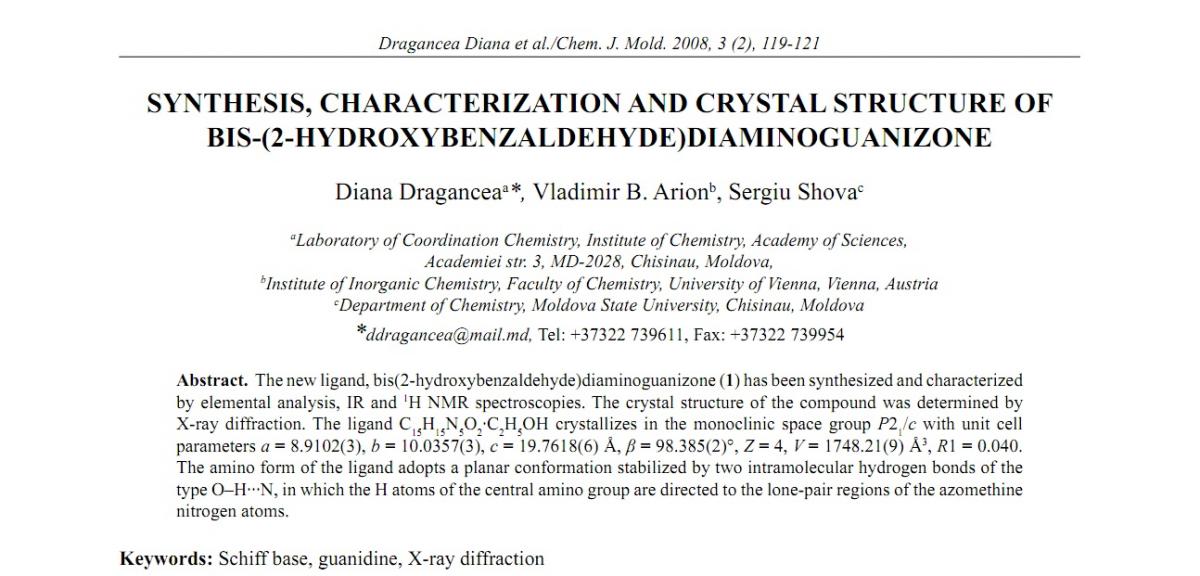
Graphical Abstract: The new ligand, bis(2-hydroxybenzaldehyde)diaminoguanizone (1) has been synthesized and characterized by elemental analysis, IR and 1H NMR spectroscopies. The crystal structure of the compound was determined by X-ray diffraction. The ligand C15H15N5O2·C2H5OH crystallizes in the monoclinic space group P21/c with unit cell parameters a = 8.9102(3), b = 10.0357(3), c = 19.7618(6) Å, β = 98.385(2)°, Z = 4, V = 1748.21(9) Å3, R1 = 0.040. The amino form of the ligand adopts a planar conformation stabilized by two intramolecular hydrogen bonds of the type O–H···N, in which the H atoms of the central amino group are directed to the lone-pair regions of the azomethine nitrogen atoms.
Downloads: 28
Author(s):
Field: Inorganic and coordination chemistry
Type: Research paper
Issue: 2008 Volume 3, no.2
Pages: 70-80
Eduard Coropceanu, Alexandra Deseatnic, Maria Stratan, Andrei Rija, Olga Bologa, Janna Tiurin, Svetlana Labliuc, Steliana Clapco, Ion Bulhac
Field: Inorganic and coordination chemistry
Type: Research paper
Issue: 2008 Volume 3, no.2
Pages: 70-80
Full Text (PDF): Download
DOI: dx.doi.org/10.19261/cjm.2008.03(2).15
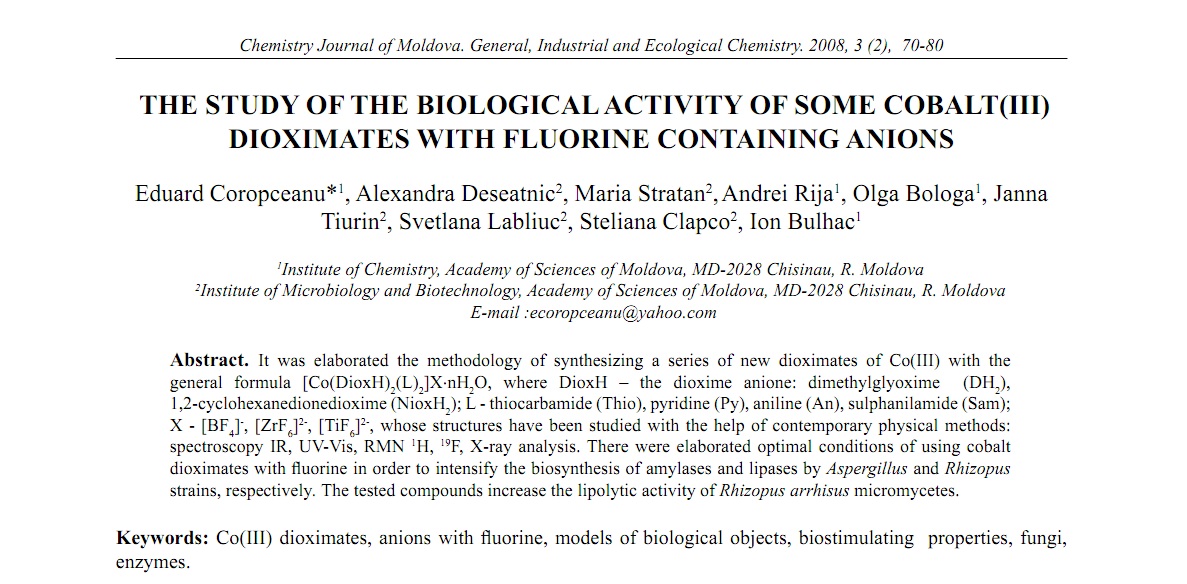
Graphical Abstract: It was elaborated the methodology of synthesizing a series of new dioximates of Co(III) with the general formula [Co(DioxH)2(L)2]X⋅nH2O, where DioxH – the dioxime anione: dimethylglyoxime (DH2), 1,2-cyclohexanedionedioxime (NioxH2); L - thiocarbamide (Thio), pyridine (Py), aniline (An), sulphanilamide (Sam);X - [BF4]-, [ZrF6]2-, [TiF6]2-, whose structures have been studied with the help of contemporary physical methods: spectroscopy IR, UV-Vis, RMN 1H, 19F, X-ray analysis. There were elaborated optimal conditions of using cobalt dioximates with fluorine in order to intensify the biosynthesis of amylases and lipases by Aspergillus and Rhizopus strains, respectively. The tested compounds increase the lipolytic activity of Rhizopus arrhisus micromycetes.
Downloads: 32
Author(s):
Field: Inorganic and coordination chemistry
Type: Review
Issue: 2008 Volume 3, no.2
Pages: 38-46
M.Cocu, J. Gradinaru, M. Revenco, E. Rybak-Akimova, N. Gărbălău
Field: Inorganic and coordination chemistry
Type: Review
Issue: 2008 Volume 3, no.2
Pages: 38-46
Full Text (PDF): Download
DOI: dx.doi.org/10.19261/cjm.2008.03(2).16
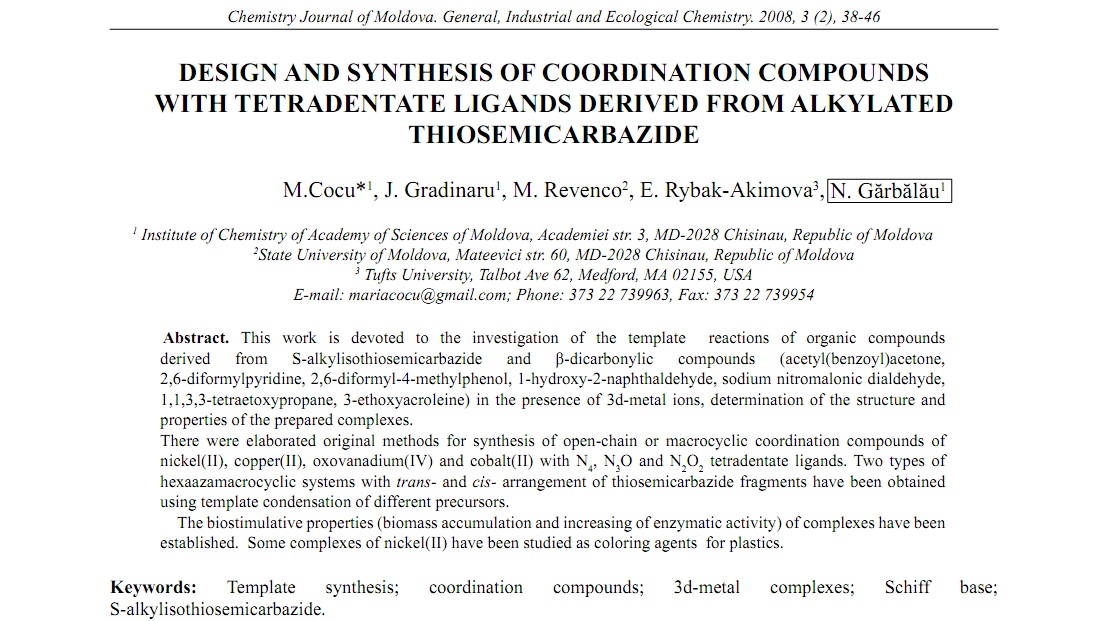
Graphical Abstract: This work is devoted to the investigation of the template reactions of organic compounds derived from S-alkylisothiosemicarbazide and β-dicarbonylic compounds (acetyl(benzoyl)acetone, 2,6-diformylpyridine, 2,6-diformyl-4-methylphenol, 1-hydroxy-2-naphthaldehyde, sodium nitromalonic dialdehyde, 1,1,3,3-tetraetoxypropane, 3-ethoxyacroleine) in the presence of 3d-metal ions, determination of the structure and properties of the prepared complexes. There were elaborated original methods for synthesis of open-chain or macrocyclic coordination compounds of nickel(II), copper(II), oxovanadium(IV) and cobalt(II) with N4, N3O and N2O2 tetradentate ligands. Two types of hexaazamacrocyclic systems with trans- and cis- arrangement of thiosemicarbazide fragments have been obtained using template condensation of different precursors. The biostimulative properties (biomass accumulation and increasing of enzymatic activity) of complexes have been established. Some complexes of nickel(II) have been studied as coloring agents for plastics.
Downloads: 67
Author(s):
Field: Inorganic and coordination chemistry
Type: Research paper
Issue: 2007 Volume 2, no.1
Pages: 102-107
Takanori Kotera, Tsukasa Sugimoto and Masahiro Mikuriya
Field: Inorganic and coordination chemistry
Type: Research paper
Issue: 2007 Volume 2, no.1
Pages: 102-107
Full Text (PDF): Download
DOI: dx.doi.org/10.19261/cjm.2007.02(1).06
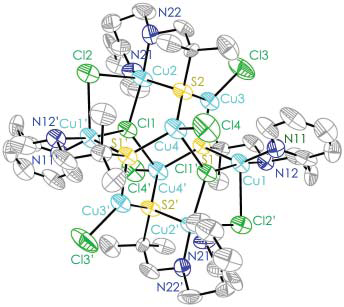
Graphical Abstract: Thiolato-bridged complex [CuI4CuII4(peampt)4Cl8]·2H2O (Hpeampt = 1-(2-pyridylethyl)amino) methylpropane-2-thiol) has been synthesized and characterized by the elemental analysis, IR and UV-vis spectroscopies and magnetic susceptibility measurement. The X-ray crystal structure analysis of this complex shows a localized mixed-valence octanuclear cage structure made up of four trigonal-bipyramidal CuIIN2SCl2, two trigonal CuIS2Cl, and two tetrahedral CuIS2Cl2 coordination sites. Temperature dependence of magnetic susceptibility (4.5— 300 K) shows that a fairly strong antiferromagnetic interaction is operating between the four CuII ions.
Downloads: 23
Author(s):
Field: Inorganic and coordination chemistry
Type: Research paper
Issue: 2007 Volume 2, no.1
Pages: 98-101
Adina N. Lazar, Oksana Danylyuk, Kinga Suwinska and Anthony W. Coleman
Field: Inorganic and coordination chemistry
Type: Research paper
Issue: 2007 Volume 2, no.1
Pages: 98-101
Full Text (PDF): Download
DOI: dx.doi.org/10.19261/cjm.2007.02(1).07
Graphical Abstract: T
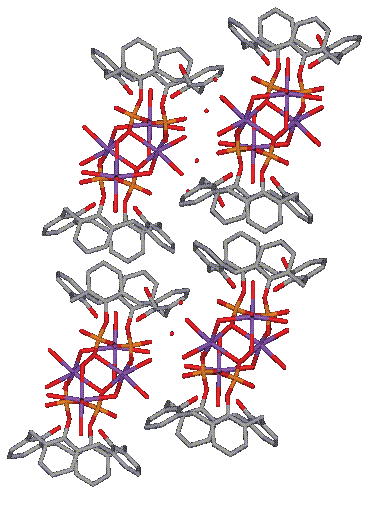 he solid-state structure of the tri-potassium calix[4]arene dihydroxyphosphonate salt is presented. In this structure, two potassium cations bridge between layers of dimeric calixarene diphosphonate units and two other potassium cations bridge along the face of the layers. The ubiquitous dimeric association of the calixarenes shows the highest interdigitation value so far observed. As expected, the cations are solvated and are complexed exo with respect to calixarene crown. The octahedral coordination sphere of the potassium cations is formed by two phosphonate groups of the calixarenes and four water molecules. Electrostatic forces represent the major element of interaction in the solid-state system.
Downloads: 15
Author(s):
Field: Inorganic and coordination chemistry
Type: Research paper
Issue: 2007 Volume 2, no.1
Pages: 93-97
Shtemenko A.V., Tretyak S.Y., Golichenko A.A.
Field: Inorganic and coordination chemistry
Type: Research paper
Issue: 2007 Volume 2, no.1
Pages: 93-97
Full Text (PDF): Download
DOI: dx.doi.org/10.19261/cjm.2007.02(1).08
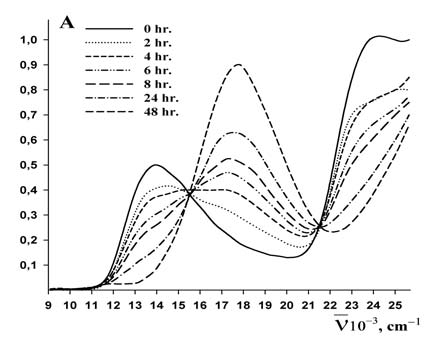
Graphical Abstract: The interaction of cis-Re2(RCOO)2Cl4, trans-Re2(RCOO)2Cl4, Re2(RCOO)3Cl3 and Re2(RCOO)4Cl2 (where R - alkyl group) with 1,3,5-triphenylverdazyle radical in 1,2-dichlorethane was investigated. It is discovered, that gradual substitution of halogenide ligands by carboxylates in dirhenium(III) clusters led to slowing down of reaction with a radical due to different influence of these ligands on parameters of rhenium - rhenium bond. Presented data showed perspectivity of Re26+-substances applications as therapeutic agents due to their low toxicity and antiradical properties that occured by δ-component of quadruple Re-Re bond electron transition.
Downloads: 16
Author(s):
Field: Inorganic and coordination chemistry
Type: Research paper
Issue: 2007 Volume 2, no.1
Pages: 88-92
Krisztina Kovács, Alexander A. Kamnev, Alexei G. Shchelochkov, Ernő Kuzmann, János Mink 3, Tünde Megyes, Attila Vértes
Field: Inorganic and coordination chemistry
Type: Research paper
Issue: 2007 Volume 2, no.1
Pages: 88-92
Full Text (PDF): Download
DOI: dx.doi.org/10.19261/cjm.2007.02(1).09
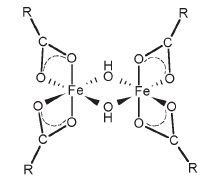
Graphical Abstract: Interactions of a series of indole-3-alkanoic acids (with n-alkanoic acid side-chains from C1 to C4) with iron(III) in acidic aqueous solutions have been shown to comprise two parallel processes including complexation and redox transformations giving iron(II) hexaaquo complexes. The structure and composition of the reaction products are discussed, as analysed using a combination of instrumental techniques including 57Fe Mössbauer, vibrational and HNMR spectroscopies.
Downloads: 14
Author(s):
Field: Inorganic and coordination chemistry
Type: Research paper
Issue: 2007 Volume 2, no.1
Pages: 83-87
Sergiy Smola, Natalya Rusakova, Elena Martsinko, Inna Seifullina, Yuriy Korovin
Field: Inorganic and coordination chemistry
Type: Research paper
Issue: 2007 Volume 2, no.1
Pages: 83-87
Full Text (PDF): Download
DOI: dx.doi.org/10.19261/cjm.2007.02(1).10
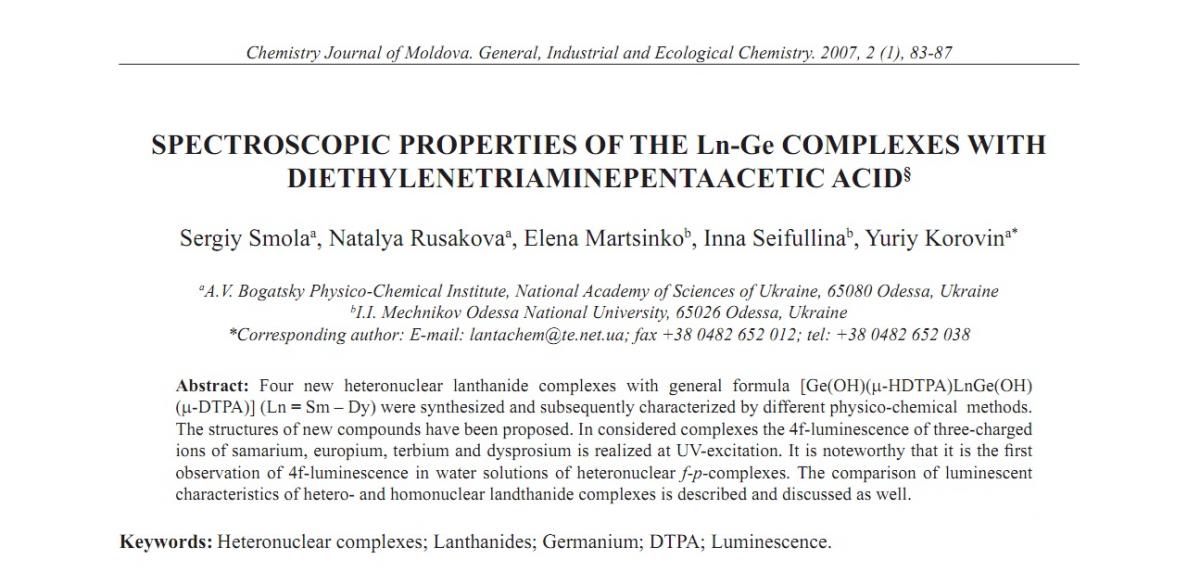
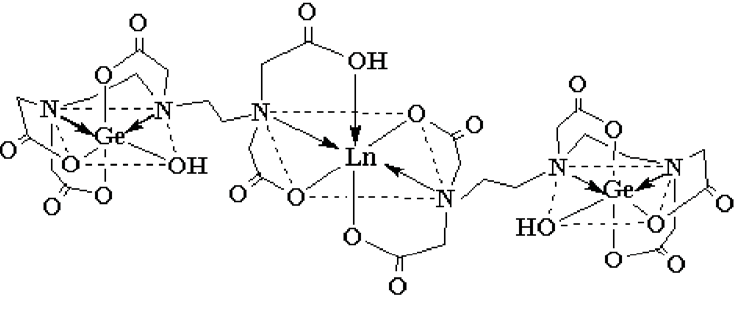
Graphical Abstract: Four new heteronuclear lanthanide complexes with general formula [Ge(OH)(μ-HDTPA)LnGe(OH) (μ-DTPA)] (Ln = Sm – Dy) were synthesized and subsequently characterized by different physico- chemical methods. The structures of new compounds have been proposed. In considered complexes the 4f-luminescence of three-charged ions of samarium, europium, terbium and dysprosium is realized at UV-excitation. It is noteworthy that it is the first observation of 4f-luminescence in water solutions of heteronuclear f-p-complexes. The comparison of luminescent characteristics of hetero- and homonuclear landthanide complexes is described and discussed as well.
Downloads: 18
Author(s):
Field: Inorganic and coordination chemistry
Type: Review
Issue: 2007 Volume 2, no.1
Pages: 17-35
Boris Tsukerblat, Alex Tarantul, Achim Müller
Field: Inorganic and coordination chemistry
Type: Review
Issue: 2007 Volume 2, no.1
Pages: 17-35
Full Text (PDF): Download
DOI: dx.doi.org/10.19261/cjm.2007.02(1).17
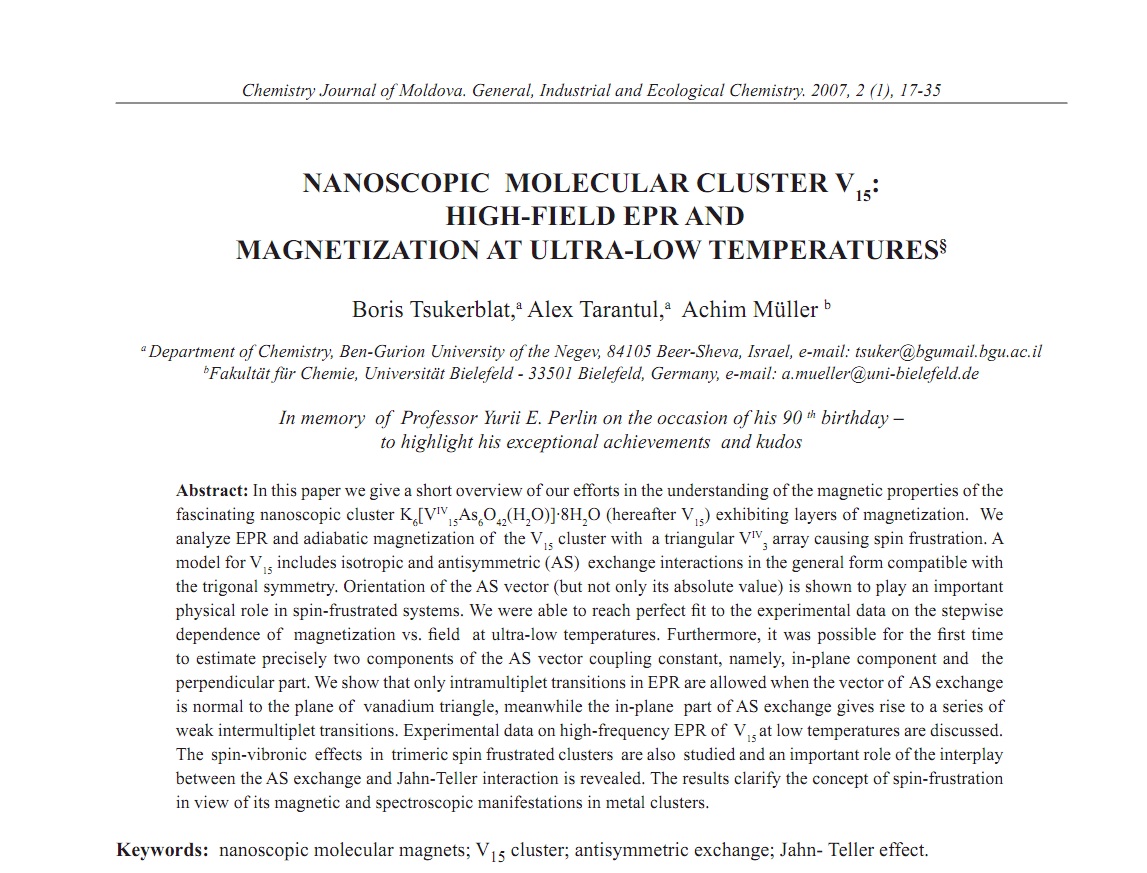
Graphical Abstract: In this paper we give a short overview of our efforts in the understanding of the magnetic properties of the fascinating nanoscopic cluster K6[VIV15As6O42(H2O)]·8H2O (hereafter V15) exhibiting layers of magnetization. We analyze EPR and adiabatic magnetization of the V15 cluster with a triangular VIV3 array causing spin frustration. A model for V15 includes isotropic an
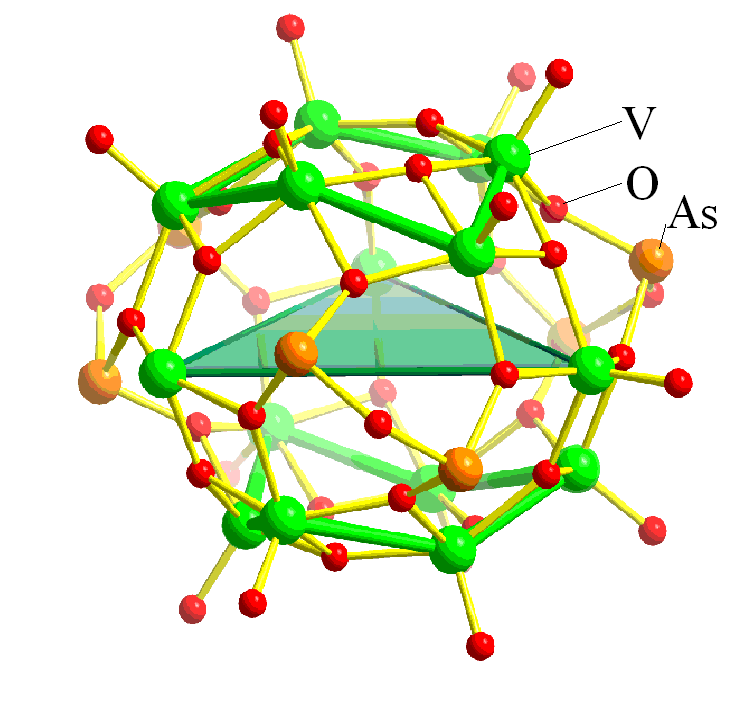 d antisymmetric (AS) exchange interactions in the general form compatible with the trigonal symmetry. Orientation of the AS vector (but not only its absolute value) is shown to play an important physical role in spin-frustrated systems. We were able to reach perfect fit to the experimental data on the stepwise dependence of magnetization vs. field at ultra-low temperatures. Furthermore, it was possible for the first time to estimate precisely two components of the AS vector coupling constant, namely, in-plane component and the perpendicular part. We show that only intramultiplet transitions in EPR are allowed when the vector of AS exchange is normal to the plane of vanadium triangle, meanwhile the in-plane part of AS exchange gives rise to a series of weak intermultiplet transitions. Experimental data on high-frequency EPR of V15 at low temperatures are discussed. The spin-vibronic effects in trimeric spin frustrated clusters are also studied and an important role of the interplay between the AS exchange and Jahn-Teller interaction is revealed. The results clarify the concept of spin-frustration in view of its magnetic and spectroscopic manifestations in metal clusters.
Downloads: 40
Author(s):
Field: Inorganic and coordination chemistry
Type: Research paper
Issue: 2006 Volume 1, no.1
Pages: 97-99
Ghenadie Novitchi, Jean-Pierre Costes, Lilia Popovschi, Sergiu Shova, Aurelian Gulea
Field: Inorganic and coordination chemistry
Type: Research paper
Issue: 2006 Volume 1, no.1
Pages: 97-99
Full Text (PDF): Download
DOI: dx.doi.org/10.19261/cjm.2006.01(1).03
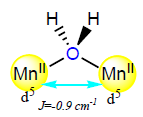
Graphical Abstract: The magnetic susceptibility (χT) of an unusual dissymmetric binuclear manganese corboxylate complex has been measured from 2 to 300K. The magnetic data which have been fitted with help of the Heisenberg Dirac Van Vleck HDVV spin-exchange Hamiltonian H = − J S 1 S 2 , indicate that an antiferromagnetic interaction equal to J = -0.90(1) cm-1 is present. A correlation between J values and Mn-H2O-Mn angles has been tempted.
Downloads: 22