Chemistry Journal of Moldova
- Journal Citation Reports for year 2025:
- Impact Factor (IF) 0.5;
- 5-year Journal IF 0.6;
- SCOPUS Journal Metrics for year 2025:
- CiteScore 0.9;
- Source Normalized Impact per Paper (SNIP) 0.334;
- SCImago Journal Rank (SJR) 0.152.




TOP DOWNLOADED ARTICLES
1. SONOCHEMICAL SYNTHESIS OF HEMATITE
NANOPARTICLES
Mihail Iacob
(downloads: 1342)
2. THE ROLE OF HALOGEN BONDING IN THE
SYNTHESIS AND DESIGN OF TAP COMPLEXES
Namiq Shikhaliyev, Ayten Niyazova, Abel Maharramov, Agaisa Askerov, Nazrin Zeynalli, Viktor Khrustalev, Peri Huseynova
(downloads: 934)
3. SILVER AND ZINC NANOPARTICLES
BIOSYNTHESIS USING LAUREL EXTRACT AND
INVESTIGATION OF THE PHOTOCATALYTIC
PROPERTIES
Recep Taş, Ebru Köroğlu, Ahmet Karakuş, Ali Savaş Bülbül, Nilay Akkuş Taş
(downloads: 908)
4. SYNTHESIS OF DIFFERENT STRUCTURAL TYPES
OF ZEOLITES IN THE
HALLOYSITE-DOLOMITE-OBSIDIAN SYSTEM
Gunel Mamedova
(downloads: 870)
5. DERIVATIZATION TECHNIQUES BASED ON
CHARGE TRANSFER REACTIONS FOR
SPECTROPHOTOMETRIC DETERMINATION OF
JOSAMYCIN IN VARIOUS DOSAGE FORMS
Abdelghani Mahmoudi and Ann Van Schepdael
(downloads: 832)
6. A NOVEL GREEN SYNTHESIS OF NICKEL OXIDE
NANOPARTICLES USING ARABIC GUM
Saeid Taghavi Fardood, Ali Ramazani, Sajjad Moradi
(downloads: 809)
7. SYNTHESIS, CHARACTERIZATION AND
MOLECULAR DOCKING OF CHLORO-SUBSTITUTED
HYDROXYXANTHONE DERIVATIVES
Emmy Yuanita, Harno Dwi Pranowo, Mustofa Mustofa, Respati Tri Swasono, Jufrizal Syahri, Jumina Jumina
(downloads: 658)
8. ORGANOCHLORINE PESTICIDES RESIDUES IN
SOIL OF SOROCA DISTRICT, REPUBLIC OF
MOLDOVA
Elena Culighin
(downloads: 509)
9. ROLE OF CYCLODEXTRINS IN NEW
ANTIMYCOBACTERIAL FORMULATIONS
Veaceslav Boldescu, Fliur Macaev, Gheorghe Duca
(downloads: 502)
10. INVESTIGATION OF VARIOUS INFLUENCING
FACTORS OF HYDROTHERMAL SYNTHESIS OF
ANALCIME ZEOLITE
Gunel Mamedova, Gunel Nasirli
(downloads: 486)
NANOPARTICLES
Mihail Iacob
(downloads: 1342)
2. THE ROLE OF HALOGEN BONDING IN THE
SYNTHESIS AND DESIGN OF TAP COMPLEXES
Namiq Shikhaliyev, Ayten Niyazova, Abel Maharramov, Agaisa Askerov, Nazrin Zeynalli, Viktor Khrustalev, Peri Huseynova
(downloads: 934)
3. SILVER AND ZINC NANOPARTICLES
BIOSYNTHESIS USING LAUREL EXTRACT AND
INVESTIGATION OF THE PHOTOCATALYTIC
PROPERTIES
Recep Taş, Ebru Köroğlu, Ahmet Karakuş, Ali Savaş Bülbül, Nilay Akkuş Taş
(downloads: 908)
4. SYNTHESIS OF DIFFERENT STRUCTURAL TYPES
OF ZEOLITES IN THE
HALLOYSITE-DOLOMITE-OBSIDIAN SYSTEM
Gunel Mamedova
(downloads: 870)
5. DERIVATIZATION TECHNIQUES BASED ON
CHARGE TRANSFER REACTIONS FOR
SPECTROPHOTOMETRIC DETERMINATION OF
JOSAMYCIN IN VARIOUS DOSAGE FORMS
Abdelghani Mahmoudi and Ann Van Schepdael
(downloads: 832)
6. A NOVEL GREEN SYNTHESIS OF NICKEL OXIDE
NANOPARTICLES USING ARABIC GUM
Saeid Taghavi Fardood, Ali Ramazani, Sajjad Moradi
(downloads: 809)
7. SYNTHESIS, CHARACTERIZATION AND
MOLECULAR DOCKING OF CHLORO-SUBSTITUTED
HYDROXYXANTHONE DERIVATIVES
Emmy Yuanita, Harno Dwi Pranowo, Mustofa Mustofa, Respati Tri Swasono, Jufrizal Syahri, Jumina Jumina
(downloads: 658)
8. ORGANOCHLORINE PESTICIDES RESIDUES IN
SOIL OF SOROCA DISTRICT, REPUBLIC OF
MOLDOVA
Elena Culighin
(downloads: 509)
9. ROLE OF CYCLODEXTRINS IN NEW
ANTIMYCOBACTERIAL FORMULATIONS
Veaceslav Boldescu, Fliur Macaev, Gheorghe Duca
(downloads: 502)
10. INVESTIGATION OF VARIOUS INFLUENCING
FACTORS OF HYDROTHERMAL SYNTHESIS OF
ANALCIME ZEOLITE
Gunel Mamedova, Gunel Nasirli
(downloads: 486)



Inorganic and coordination chemistry
Author(s):
Field: Inorganic and coordination chemistry
Type: Research paper
Issue: 2015 Volume 10, no.1
Pages: 46-51
Mihail Iacob
Field: Inorganic and coordination chemistry
Type: Research paper
Issue: 2015 Volume 10, no.1
Pages: 46-51
Full Text (PDF): Download
DOI: dx.doi.org/10.19261/cjm.2015.10(1).06
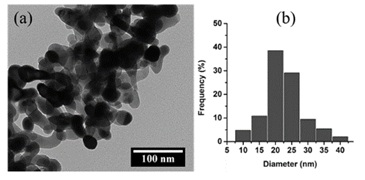
Graphical Abstract: Hematite nanoparticles were prepared by a procedure consisting in sonication of μ3-oxo trinuclear iron(III) acetate of composition [Fe3O(OOCCH3)6(H2O)3]NO3∙4H2O, {Fe3O}NO3, as iron source, in strong basic conditions followed by thermal treatment at 600˚C. The formation of the hematite was confirmed by IR spectroscopy, X-ray powder diffraction and Raman spectroscopy while the shape and size of the nanoparticles and their agglomeration were evidenced and estimated on the basis of the images taken with TEM technique.
Downloads: 1342
Author(s):
Field: Inorganic and coordination chemistry
Type: Research paper
Issue: 2015 Volume 10, no.1
Pages: 52-56
Ana Lazarescu, Elena Melnic, Sergiu Shova, Victor Kravtsov, Constantin Turta
Field: Inorganic and coordination chemistry
Type: Research paper
Issue: 2015 Volume 10, no.1
Pages: 52-56
Full Text (PDF): Download
DOI: dx.doi.org/10.19261/cjm.2015.10(1).07
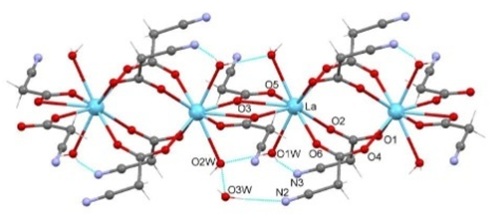
Graphical Abstract: A lanthanum(III) cyanoacetate complex {[La2(CNCH2COO)6 (H2O)4]∙H2O}n (1) was synthesized and characterized by X-ray single-crystal analysis. The complex 1 exhibits one-dimensional coordination polymer structure. Cyanoacetate ligands coordinated in the bidentate bridging and tridentate-chelating bridging modes. The cyano-group of ligand is not coordinated to the lanthanide ion.
Downloads: 76
Author(s):
Field: Inorganic and coordination chemistry
Type: Research paper
Issue: 2014 Volume 9, no.2
Pages: 62-66
Masahiro Mikuriya, Melissa Schumacher, Chinatsu Kawano, Takahiro Akihara, Kenta Ono, Daisuke Yoshioka, Hiroshi Sakiyama, Makoto Handa
Field: Inorganic and coordination chemistry
Type: Research paper
Issue: 2014 Volume 9, no.2
Pages: 62-66
Full Text (PDF): Download
DOI: dx.doi.org/10.19261/cjm.2014.09(2).09
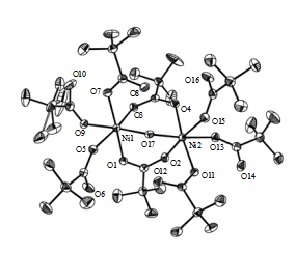
Graphical Abstract: Dinuclear nickel(II) pivalate with µ-aqua- and di-µ-pivalato-bridges having monodentate pivalato and monodentate pivalic acid molecules, [Ni2{O2CC(CH3)3}4(OH2){HO2CC(CH3)3}4], was prepared and characterized by elemental analysis and IR and UV-Vis spectroscopies, temperature dependence of magnetic susceptibilities (4.5—300K), and single-crystal X-ray crystallography. The magnetic data analysis showed a ferromagnetic interaction between the two nickel atoms.
Downloads: 61
Author(s):
Field: Inorganic and coordination chemistry
Type: Research paper
Issue: 2014 Volume 9, no.1
Pages: 93-99
Masahiro Mikuriya, Yusuke Tanaka, Daisuke Yoshioka, Makoto Handa
Field: Inorganic and coordination chemistry
Type: Research paper
Issue: 2014 Volume 9, no.1
Pages: 93-99
Full Text (PDF): Download
DOI: dx.doi.org/10.19261/cjm.2014.09(1).11
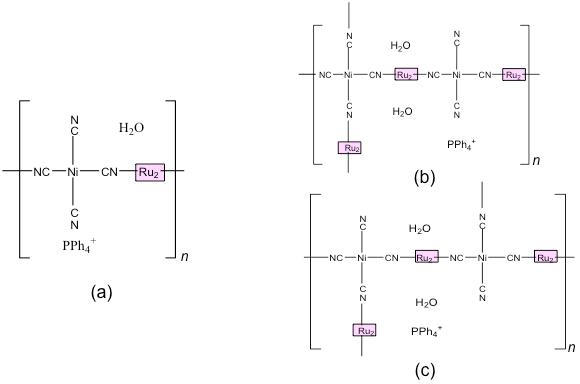
Graphical Abstract: Mixed-metal chain complexes constructed from lantern-type dinuclear ruthenium(II,III) carboxylate unit and tetracyanidonickelate(II), (PPh4)n[Ru2(O2CCH3)4Ni(CN)4]n•nH2O (1) and (PPh4)n[Ru2{O2CC(CH3)3}4]3n[Ni(CN)4]2n•2nH2O (2), where very weak antiferromagnetic interaction is operating, were synthesized and characterized by elemental analysis and IR and UV-vis spectroscopies and temperature dependence of magnetic susceptibilities (4.5—300K).
Downloads: 43
Author(s):
Field: Inorganic and coordination chemistry
Type: Research paper
Issue: 2014 Volume 9, no.1
Pages: 100-105
Masahiro Mikuriya, Nobuyuki Nagao, Satoshi Kurahashi, Atsushi Tabuchi, Seiki Tomohara, Motohiro Tsuboi, Daisuke Yoshioka, Hiroshi Sakiyama, Akira Fuyuhiro
Field: Inorganic and coordination chemistry
Type: Research paper
Issue: 2014 Volume 9, no.1
Pages: 100-105
Full Text (PDF): Download
Abstract (PDF)
DOI: dx.doi.org/10.19261/cjm.2014.09(1).12
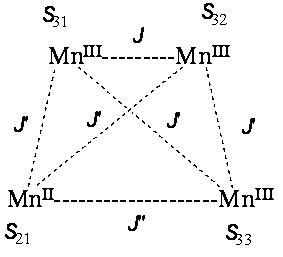
Graphical Abstract: Mixed-valent tetranuclear MnIIMnIII3 complex with 1,3-dimino-2-hydroxypropane-N,N’-N”-N”’-tetracetic acid, Ca2[Mn4{µ-OHO}(dhpta)2(CH3COO)2], where considerable antiferromagnetic interactions are operating, was synthesized and characterized by elemental analysis and IR and UV-vis spectroscopies, temperature dependence of magnetic susceptibilities (4.5—300K), and single-crystal X-ray crystallography.
Downloads: 41
DOI: dx.doi.org/10.19261/cjm.2014.09(1).12
Graphical Abstract: Mixed-valent tetranuclear MnIIMnIII3 complex with 1,3-dimino-2-hydroxypropane-N,N’-N”-N”’-tetracetic acid, Ca2[Mn4{µ-OHO}(dhpta)2(CH3COO)2], where considerable antiferromagnetic interactions are operating, was synthesized and characterized by elemental analysis and IR and UV-vis spectroscopies, temperature dependence of magnetic susceptibilities (4.5—300K), and single-crystal X-ray crystallography.
Downloads: 41
Author(s):
Field: Inorganic and coordination chemistry
Type: Review
Issue: 2013 Volume 8, no.2
Pages: 8-20
Andrei Rija, Eduard Coropceanu
Field: Inorganic and coordination chemistry
Type: Review
Issue: 2013 Volume 8, no.2
Pages: 8-20
Full Text (PDF): Download
DOI: dx.doi.org/10.19261/cjm.2013.08(2).01
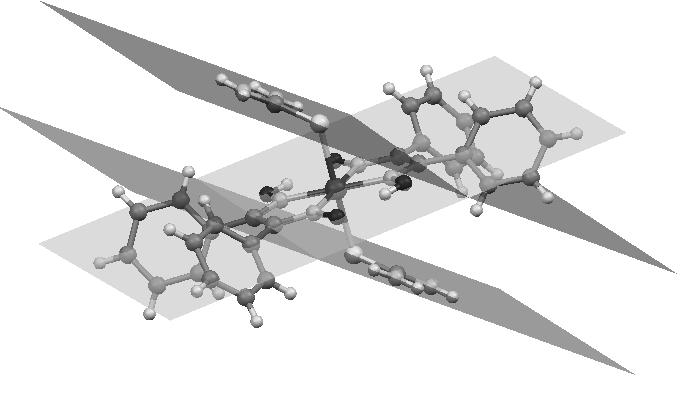
Graphical Abstract: As a result of the comparative study of axial ligand orientation towards the equatorial plane in α - dioximates Co (III) obtained by us and those described in the specialized literature (found in Cambridge Crystallographic Data Centre) showed that the external anions and solvent molecules contribute to the orientation of axial ligands as selenourea and thiourea. For aniline and sulphanilamide ligands, is more convenient the parallel orientation to form π-π interactions between the aromatic rings of ligands and the metallocycle of equatorial plane.
Downloads: 31
Author(s):
Field: Inorganic and coordination chemistry
Type: Research paper
Issue: 2013 Volume 8, no.2
Pages: 78-82
Carolina Vomisescu, Paulina Bourosh, Victor Kravtsov, Diana Dragancea
Field: Inorganic and coordination chemistry
Type: Research paper
Issue: 2013 Volume 8, no.2
Pages: 78-82
Full Text (PDF): Download
DOI: dx.doi.org/10.19261/cjm.2013.08(2).09
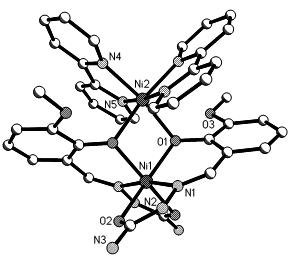
Graphical Abstract: An ONO tridentate semicarbazone Schiff base and a bidentate dipyridyl ligand give a nickel(II) dimer, where atom centers are bridged by phenolate oxygen donors.
Downloads: 57
Author(s):
Field: Inorganic and coordination chemistry
Type: Research paper
Issue: 2013 Volume 8, no.2
Pages: 83-89
Viorina Gorinchoy, Sergiu Shova, Elena Melnic, Victor Kravtsov, ConstantinTurta
Field: Inorganic and coordination chemistry
Type: Research paper
Issue: 2013 Volume 8, no.2
Pages: 83-89
Full Text (PDF): Download
DOI: dx.doi.org/10.19261/cjm.2013.08(2).10
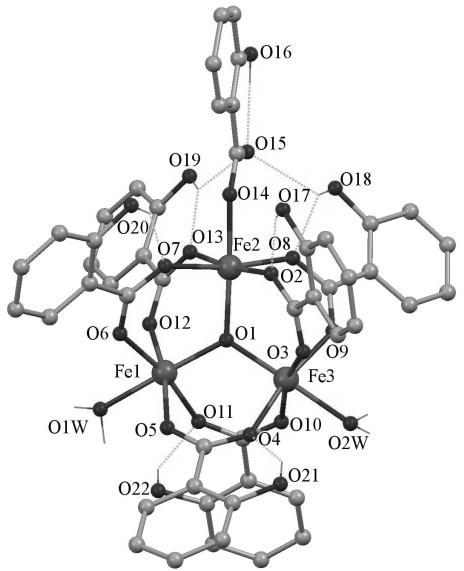
Graphical Abstract: A reaction of iron and barium nitrate with ammonium salicylate in the mixture of solvents leads to the formation of the new homotrinuclear complex, [Fe3O(SalH)7(H2O)2]∙(DMAA)2(MeOH)(THF)1,5(H2O)2,6. Single-crystal X-ray study shows that the titled complex with the moiety {Fe3O} belongs to the well-known group of μ3-oxohomotrinuclear carboxylates. The IR and MS studies are in accordance with x-ray data. Thermal behaviour of the complex was studied.
Downloads: 68
Author(s):
Field: Inorganic and coordination chemistry
Type: Research paper
Issue: 2013 Volume 8, no.1
Pages: 58-77
V. Lozan
Field: Inorganic and coordination chemistry
Type: Research paper
Issue: 2013 Volume 8, no.1
Pages: 58-77
Full Text (PDF): Download
DOI: dx.doi.org/10.19261/cjm.2013.08(1).08
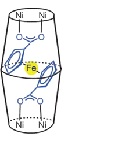
Graphical Abstract: A series of novel tri-, tetra- and pentanuclear complexes composed of dinuclear LM units (M=Co, Ni, Zn; L=24-membered macrocyclic hexaaza-dithiophenolate ligand) and ferrocenecarboxylate ([CpFeC5H4CO2]ˉ), 1,1’-ferrocenedicarboxy-late ([Fe(C5H4-CO2)2]2ˉ), acetylene-dicarboxylate, terephthalate, isophthalate, and naphthalene diimide dicarboxylate groups is reported. The complexes, have been synthesized and characterised by UV/Vis-, IR-, NMR-spectroscopy, Cyclovoltammetry, and X-ray crystallography. Each dicarboxylate dianion acts as a quadridentate bridging ligand linking two bioctahedral LM2 units via µ1,3-bridging carboxylate functions to generate discrete dications with a central LM2(O2C-R-CO2)M2L core. The magnetic properties of these compounds reveal the presence of weak ferromagnetic exchange interactions between the NiII ions of the dinuclear subunits and negligible coupling across the dicarboxylate bridges.
Downloads: 37
Author(s):
Field: Inorganic and coordination chemistry
Type: Research paper
Issue: 2013 Volume 8, no.1
Pages: 78-82
О. Ciobanica, P. Bourosh, О. Bologa, I. Bulhac, V. Lozan, V. Shofransky
Field: Inorganic and coordination chemistry
Type: Research paper
Issue: 2013 Volume 8, no.1
Pages: 78-82
Full Text (PDF): Download
DOI: dx.doi.org/10.19261/cjm.2013.08(1).09
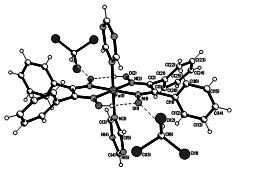
Graphical Abstract: The interaction of [Fe(DfgH)2Py2] (where DfgH=monodeprotonated diphenylglyioxime, Py-pyridune) and 1,3,5-triazine (Trz) in chloroform resulted in a new coordination compound with the composition [Fe(DfgH)2(Trz)2]·2CHCl3 (1). The crystal structure of 1, determined by single crystal X-ray diffraction, revealed that Fe(II) atom is coordinated by four oximic nitrogen atoms of two DfgH and two nitrogen atoms of two Trz ligands resulting in octahedral surrounding.
Downloads: 35