Chemistry Journal of Moldova
- Journal Citation Reports for year 2025:
- Impact Factor (IF) 0.5;
- 5-year Journal IF 0.6;
- SCOPUS Journal Metrics for year 2025:
- CiteScore 0.9;
- Source Normalized Impact per Paper (SNIP) 0.334;
- SCImago Journal Rank (SJR) 0.152.




TOP DOWNLOADED ARTICLES
1. SONOCHEMICAL SYNTHESIS OF HEMATITE
NANOPARTICLES
Mihail Iacob
(downloads: 1351)
2. THE ROLE OF HALOGEN BONDING IN THE
SYNTHESIS AND DESIGN OF TAP COMPLEXES
Namiq Shikhaliyev, Ayten Niyazova, Abel Maharramov, Agaisa Askerov, Nazrin Zeynalli, Viktor Khrustalev, Peri Huseynova
(downloads: 949)
3. SILVER AND ZINC NANOPARTICLES
BIOSYNTHESIS USING LAUREL EXTRACT AND
INVESTIGATION OF THE PHOTOCATALYTIC
PROPERTIES
Recep Taş, Ebru Köroğlu, Ahmet Karakuş, Ali Savaş Bülbül, Nilay Akkuş Taş
(downloads: 915)
4. SYNTHESIS OF DIFFERENT STRUCTURAL TYPES
OF ZEOLITES IN THE
HALLOYSITE-DOLOMITE-OBSIDIAN SYSTEM
Gunel Mamedova
(downloads: 872)
5. DERIVATIZATION TECHNIQUES BASED ON
CHARGE TRANSFER REACTIONS FOR
SPECTROPHOTOMETRIC DETERMINATION OF
JOSAMYCIN IN VARIOUS DOSAGE FORMS
Abdelghani Mahmoudi and Ann Van Schepdael
(downloads: 833)
6. A NOVEL GREEN SYNTHESIS OF NICKEL OXIDE
NANOPARTICLES USING ARABIC GUM
Saeid Taghavi Fardood, Ali Ramazani, Sajjad Moradi
(downloads: 811)
7. SYNTHESIS, CHARACTERIZATION AND
MOLECULAR DOCKING OF CHLORO-SUBSTITUTED
HYDROXYXANTHONE DERIVATIVES
Emmy Yuanita, Harno Dwi Pranowo, Mustofa Mustofa, Respati Tri Swasono, Jufrizal Syahri, Jumina Jumina
(downloads: 670)
8. ORGANOCHLORINE PESTICIDES RESIDUES IN
SOIL OF SOROCA DISTRICT, REPUBLIC OF
MOLDOVA
Elena Culighin
(downloads: 509)
9. ROLE OF CYCLODEXTRINS IN NEW
ANTIMYCOBACTERIAL FORMULATIONS
Veaceslav Boldescu, Fliur Macaev, Gheorghe Duca
(downloads: 505)
10. INVESTIGATION OF VARIOUS INFLUENCING
FACTORS OF HYDROTHERMAL SYNTHESIS OF
ANALCIME ZEOLITE
Gunel Mamedova, Gunel Nasirli
(downloads: 494)
NANOPARTICLES
Mihail Iacob
(downloads: 1351)
2. THE ROLE OF HALOGEN BONDING IN THE
SYNTHESIS AND DESIGN OF TAP COMPLEXES
Namiq Shikhaliyev, Ayten Niyazova, Abel Maharramov, Agaisa Askerov, Nazrin Zeynalli, Viktor Khrustalev, Peri Huseynova
(downloads: 949)
3. SILVER AND ZINC NANOPARTICLES
BIOSYNTHESIS USING LAUREL EXTRACT AND
INVESTIGATION OF THE PHOTOCATALYTIC
PROPERTIES
Recep Taş, Ebru Köroğlu, Ahmet Karakuş, Ali Savaş Bülbül, Nilay Akkuş Taş
(downloads: 915)
4. SYNTHESIS OF DIFFERENT STRUCTURAL TYPES
OF ZEOLITES IN THE
HALLOYSITE-DOLOMITE-OBSIDIAN SYSTEM
Gunel Mamedova
(downloads: 872)
5. DERIVATIZATION TECHNIQUES BASED ON
CHARGE TRANSFER REACTIONS FOR
SPECTROPHOTOMETRIC DETERMINATION OF
JOSAMYCIN IN VARIOUS DOSAGE FORMS
Abdelghani Mahmoudi and Ann Van Schepdael
(downloads: 833)
6. A NOVEL GREEN SYNTHESIS OF NICKEL OXIDE
NANOPARTICLES USING ARABIC GUM
Saeid Taghavi Fardood, Ali Ramazani, Sajjad Moradi
(downloads: 811)
7. SYNTHESIS, CHARACTERIZATION AND
MOLECULAR DOCKING OF CHLORO-SUBSTITUTED
HYDROXYXANTHONE DERIVATIVES
Emmy Yuanita, Harno Dwi Pranowo, Mustofa Mustofa, Respati Tri Swasono, Jufrizal Syahri, Jumina Jumina
(downloads: 670)
8. ORGANOCHLORINE PESTICIDES RESIDUES IN
SOIL OF SOROCA DISTRICT, REPUBLIC OF
MOLDOVA
Elena Culighin
(downloads: 509)
9. ROLE OF CYCLODEXTRINS IN NEW
ANTIMYCOBACTERIAL FORMULATIONS
Veaceslav Boldescu, Fliur Macaev, Gheorghe Duca
(downloads: 505)
10. INVESTIGATION OF VARIOUS INFLUENCING
FACTORS OF HYDROTHERMAL SYNTHESIS OF
ANALCIME ZEOLITE
Gunel Mamedova, Gunel Nasirli
(downloads: 494)



2007 Volume 2, no.1
Keywords: Isaac Bersuker, quantum chemistry, Jahn-Teller effect, theory of transitional metal complexes.
Full Text (PDF): Download
Full Text (PDF): Download
Keywords: Dumitru Batir, inorganic, coordinative, biocoordinative and ecologic chemistry.
Full Text (PDF): Download
Full Text (PDF): Download
Author(s):
Field: Organic chemistry
Type: Short communication
Issue: 2007 Volume 2, no.1
Pages: 119-122
Macaev Fliur, Munteanu Viorica, Stingaci Eugenia, Barba Alic, Pogrebnoi Serghei
Field: Organic chemistry
Type: Short communication
Issue: 2007 Volume 2, no.1
Pages: 119-122
Full Text (PDF): Download
DOI: dx.doi.org/10.19261/cjm.2007.02(1).03
Graphical Abstract: Room temperature ionic liquids (ILs) have been recognized as a new generation of solvents for “green chemistry” and represent remarkably promising classes of technologically useful and fundamentally interesting materials [1-6]. Most of them are
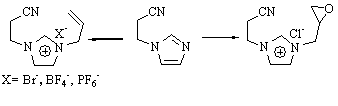 quaternary imidazolium cations with inorganic counterions. Cation in these salts is appended to the organic group (usually saturated hydrocarbon fragments). However, some problems regarding the functionalization [2,7], coordination properties [4] of ILs still remain to be solved. It seems to us that functionalization of imidazoles by ethylcarbonitrile, allyl, 2,3-epoxypropyl fragments will lead to new properties of synthesized ILs. There are no literature data on use of 2-(1H-1-imidazolyl)ethylcarbonitrile 4 for synthesis of imidazolium salts with ILs properties.
Downloads: 32
Author(s):
Field: Natural product chemistry and synthesis
Type: Research paper
Issue: 2007 Volume 2, no.1
Pages: 114-118
Pavel F. Vlad, Alexandru G. Ciocarlan, Grigore N. Mironov, Mihai N. Coltsa, Yurii A.Simonov, Victor Ch. Kravtsov and Janusz Lipkowski
Field: Natural product chemistry and synthesis
Type: Research paper
Issue: 2007 Volume 2, no.1
Pages: 114-118
Full Text (PDF): Download
DOI: dx.doi.org/10.19261/cjm.2007.02(1).04
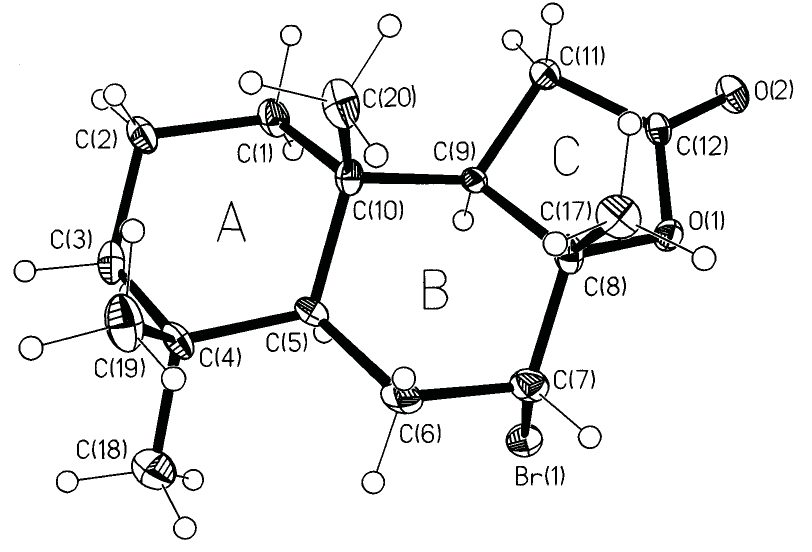
Graphical Abstract: A mixture of 7α- and 17-bromonorambreinolides was obtained on treatment of the mixture of isomeric methyl bicyclohomofarnesenoates, the norambreinolide transesterification product, with NBS and H2O2. The structure of 7α- and 17-bromonorambreinolides was elucidated on the basis of spectral data. The structure of 17-bromonorambreinolide was confirmed by its reduction with LiAlH4 into sclaradiol, and that of 7α-bromonorambreinolide by X-ray analysis.
Downloads: 13
Author(s):
Field: Natural product chemistry and synthesis
Type: Research paper
Issue: 2007 Volume 2, no.1
Pages: 108-113
Irina Lunga, Pavel Chintea, Stepan Shvets, Anna Favelb and Cosimo Pizza
Field: Natural product chemistry and synthesis
Type: Research paper
Issue: 2007 Volume 2, no.1
Pages: 108-113
Full Text (PDF): Download
DOI: dx.doi.org/10.19261/cjm.2007.02(1).05
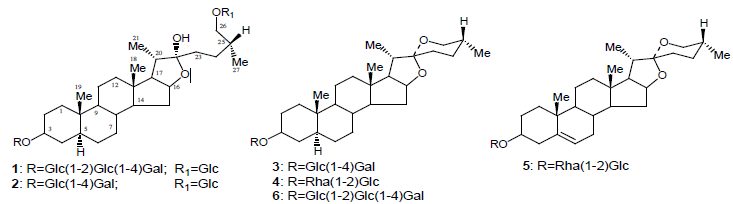
Graphical Abstract: Phytochemical analysis of the seeds of Hyocyamus niger L. (Solonaceae) resulted in the isolation of six steroidal glycosides, two furostanol (1, 2) and four spirostanol saponins (3, 4, 5, 6), which were found in this plant for the first time. The structures of these compounds were determined by detailed analysis of their spectral data, including two-dimensional NMR spectroscopy and MS spectroscopy. The antifungal activity of a crude steroidal glycoside extract, fractions of spirostanoles and individual glicosides was investigated in vitro against a panel of human pathogenic fungi, yeasts as well as dermatophytes and filamentous species.
Downloads: 53
Author(s):
Field: Inorganic and coordination chemistry
Type: Research paper
Issue: 2007 Volume 2, no.1
Pages: 102-107
Takanori Kotera, Tsukasa Sugimoto and Masahiro Mikuriya
Field: Inorganic and coordination chemistry
Type: Research paper
Issue: 2007 Volume 2, no.1
Pages: 102-107
Full Text (PDF): Download
DOI: dx.doi.org/10.19261/cjm.2007.02(1).06
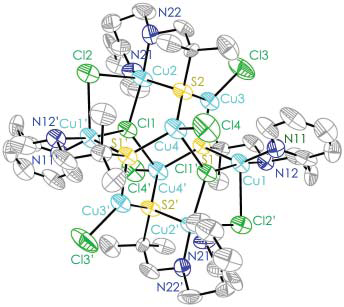
Graphical Abstract: Thiolato-bridged complex [CuI4CuII4(peampt)4Cl8]·2H2O (Hpeampt = 1-(2-pyridylethyl)amino) methylpropane-2-thiol) has been synthesized and characterized by the elemental analysis, IR and UV-vis spectroscopies and magnetic susceptibility measurement. The X-ray crystal structure analysis of this complex shows a localized mixed-valence octanuclear cage structure made up of four trigonal-bipyramidal CuIIN2SCl2, two trigonal CuIS2Cl, and two tetrahedral CuIS2Cl2 coordination sites. Temperature dependence of magnetic susceptibility (4.5— 300 K) shows that a fairly strong antiferromagnetic interaction is operating between the four CuII ions.
Downloads: 23
Author(s):
Field: Inorganic and coordination chemistry
Type: Research paper
Issue: 2007 Volume 2, no.1
Pages: 98-101
Adina N. Lazar, Oksana Danylyuk, Kinga Suwinska and Anthony W. Coleman
Field: Inorganic and coordination chemistry
Type: Research paper
Issue: 2007 Volume 2, no.1
Pages: 98-101
Full Text (PDF): Download
DOI: dx.doi.org/10.19261/cjm.2007.02(1).07
Graphical Abstract: T
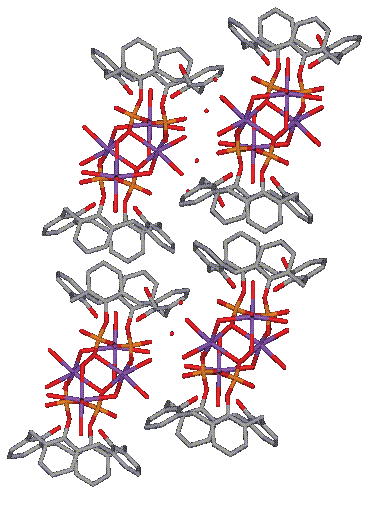 he solid-state structure of the tri-potassium calix[4]arene dihydroxyphosphonate salt is presented. In this structure, two potassium cations bridge between layers of dimeric calixarene diphosphonate units and two other potassium cations bridge along the face of the layers. The ubiquitous dimeric association of the calixarenes shows the highest interdigitation value so far observed. As expected, the cations are solvated and are complexed exo with respect to calixarene crown. The octahedral coordination sphere of the potassium cations is formed by two phosphonate groups of the calixarenes and four water molecules. Electrostatic forces represent the major element of interaction in the solid-state system.
Downloads: 15
Author(s):
Field: Inorganic and coordination chemistry
Type: Research paper
Issue: 2007 Volume 2, no.1
Pages: 93-97
Shtemenko A.V., Tretyak S.Y., Golichenko A.A.
Field: Inorganic and coordination chemistry
Type: Research paper
Issue: 2007 Volume 2, no.1
Pages: 93-97
Full Text (PDF): Download
DOI: dx.doi.org/10.19261/cjm.2007.02(1).08
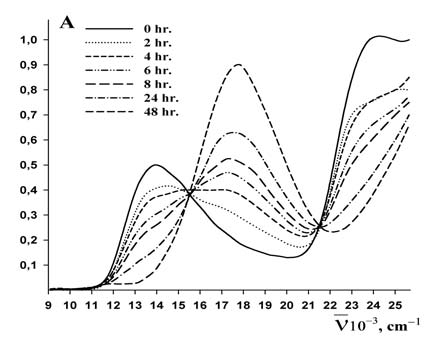
Graphical Abstract: The interaction of cis-Re2(RCOO)2Cl4, trans-Re2(RCOO)2Cl4, Re2(RCOO)3Cl3 and Re2(RCOO)4Cl2 (where R - alkyl group) with 1,3,5-triphenylverdazyle radical in 1,2-dichlorethane was investigated. It is discovered, that gradual substitution of halogenide ligands by carboxylates in dirhenium(III) clusters led to slowing down of reaction with a radical due to different influence of these ligands on parameters of rhenium - rhenium bond. Presented data showed perspectivity of Re26+-substances applications as therapeutic agents due to their low toxicity and antiradical properties that occured by δ-component of quadruple Re-Re bond electron transition.
Downloads: 16
Author(s):
Field: Inorganic and coordination chemistry
Type: Research paper
Issue: 2007 Volume 2, no.1
Pages: 88-92
Krisztina Kovács, Alexander A. Kamnev, Alexei G. Shchelochkov, Ernő Kuzmann, János Mink 3, Tünde Megyes, Attila Vértes
Field: Inorganic and coordination chemistry
Type: Research paper
Issue: 2007 Volume 2, no.1
Pages: 88-92
Full Text (PDF): Download
DOI: dx.doi.org/10.19261/cjm.2007.02(1).09
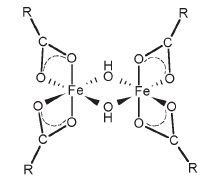
Graphical Abstract: Interactions of a series of indole-3-alkanoic acids (with n-alkanoic acid side-chains from C1 to C4) with iron(III) in acidic aqueous solutions have been shown to comprise two parallel processes including complexation and redox transformations giving iron(II) hexaaquo complexes. The structure and composition of the reaction products are discussed, as analysed using a combination of instrumental techniques including 57Fe Mössbauer, vibrational and HNMR spectroscopies.
Downloads: 14
Author(s):
Field: Inorganic and coordination chemistry
Type: Research paper
Issue: 2007 Volume 2, no.1
Pages: 83-87
Sergiy Smola, Natalya Rusakova, Elena Martsinko, Inna Seifullina, Yuriy Korovin
Field: Inorganic and coordination chemistry
Type: Research paper
Issue: 2007 Volume 2, no.1
Pages: 83-87
Full Text (PDF): Download
DOI: dx.doi.org/10.19261/cjm.2007.02(1).10
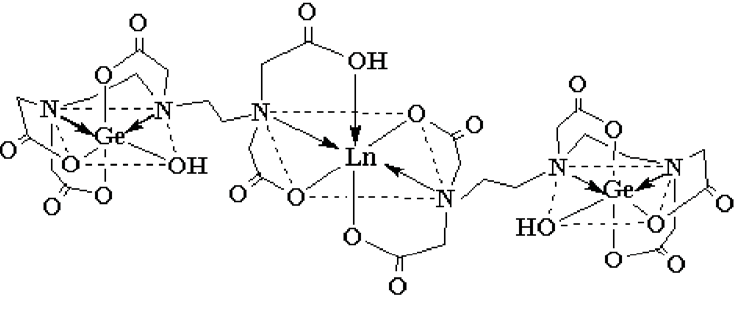
Graphical Abstract: Four new heteronuclear lanthanide complexes with general formula [Ge(OH)(μ-HDTPA)LnGe(OH) (μ-DTPA)] (Ln = Sm – Dy) were synthesized and subsequently characterized by different physico- chemical methods. The structures of new compounds have been proposed. In considered complexes the 4f-luminescence of three-charged ions of samarium, europium, terbium and dysprosium is realized at UV-excitation. It is noteworthy that it is the first observation of 4f-luminescence in water solutions of heteronuclear f-p-complexes. The comparison of luminescent characteristics of hetero- and homonuclear landthanide complexes is described and discussed as well.
Downloads: 18